[Ubuntu] [Docker] Need help with Nvidia hardware acceleration in Jellyfin
from LazerDickMcCheese@sh.itjust.works to selfhosted@lemmy.world on 15 Feb 2026 15:58
https://sh.itjust.works/post/55397111
from LazerDickMcCheese@sh.itjust.works to selfhosted@lemmy.world on 15 Feb 2026 15:58
https://sh.itjust.works/post/55397111
Does anyone have a compose.yaml for an Nvidia GPU that works that they would like to share? Here’s my current file, it gives a white screen with “server error” on it: pastebin.com/AaV17cTz
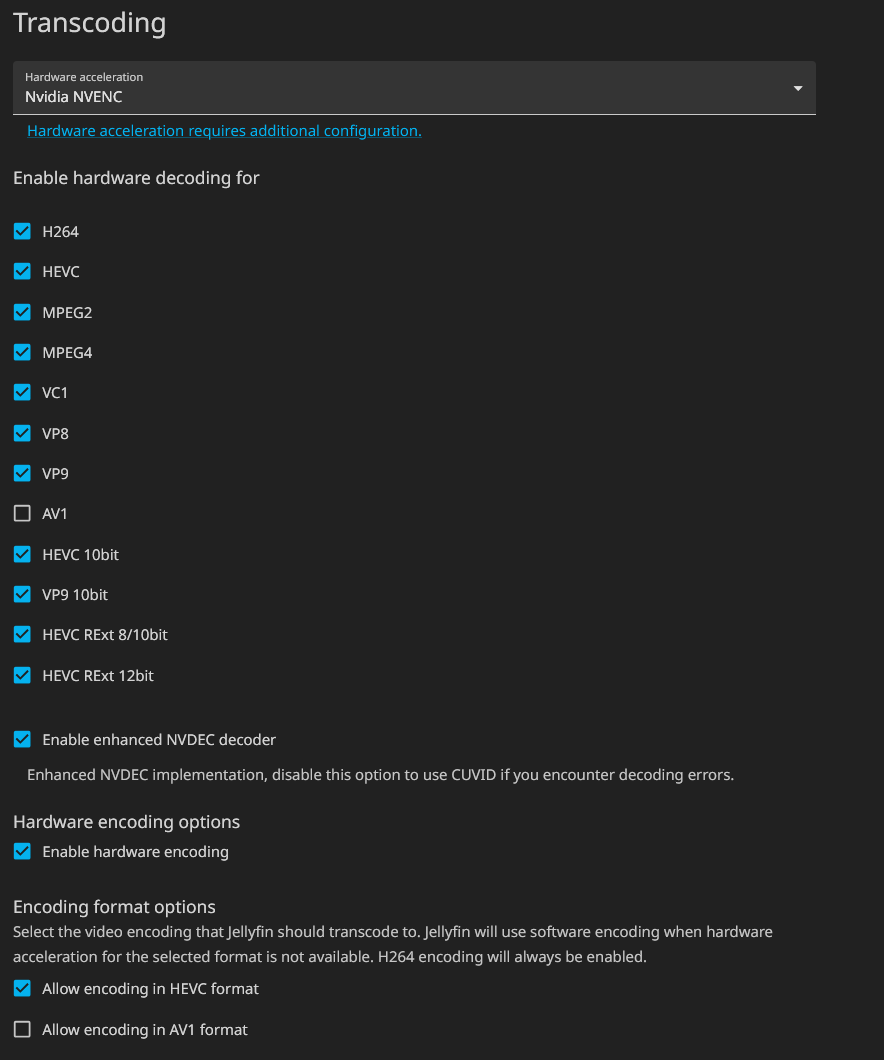
I went through Jellyfin’s instructions on setting a GPU up, but the instructions weren’t clear (in my opinion) so who knows if it’s correct. I installed some Nvidia tools as a prerequisite and ‘nvidia-smi’ shows the card. I attached my Jellyfin settings from before it self-destructed according to Nvidia’s transcoding matrix (which also wasn’t descriptive enough in my opinion), do they look right for a 2080?
Update: after making this post, and changing nothing, it suddenly works
threaded - newest
Here are some relevant stuff, also have nvidia drivers and vids libs installed.
Running in a podman quadlet on fedora
After=nvidia-cdi-generator
[Container]
Image=docker.io/jellyfin/jellyfin
PodmanArgs=–privileged --gpus=all
Environment=NVIDIA_VISIBLE_DEVICES=all
AddDevice=/dev/dri/card0:/dev/dri/card0
I have an intel igpu. It was hella painful to pass through the guy into a normal container and I never figured it out. I just ended up running the container with the —privileged flag. QuickSync hwaccel works fine now, I assume it would be the same for NVENC, since the flag basically just passes everything to the container.
Huh? I have an ARC A380 and I just followed the tutorial. AFAICT everything’s working fine.
jellyfin.org/docs/general/post-install/…/intel#co…
Jellyfin isn’t the most secure piece of software out there, I would avoid giving it permissions it doesn’t need.
Step 1) Check /dev/dri for the GPU
Documentation indicates renderDXXX typically refers to Intel GPU’s
sudo docker compose up -d; sudo docker exec -it jellyfin bashOnce inside
ls/dev/dri to confirm the GPU is recognized inside the container, once you confirm it then you can exit the container.<img alt="" src="https://sh.itjust.works/pictrs/image/9d0f6573-4286-457f-8fc6-3215e922914e.jpeg">
.
This works for me, rtx 4060
jellyfin: image: jellyfin/jellyfin:latest container_name: jellyfin user: 108:114 network_mode: 'host' environment: - JELLYFIN_CACHE_DIR=/var/cache/jellyfin - JELLYFIN_CONFIG_DIR=/etc/jellyfin - JELLYFIN_DATA_DIR=/var/lib/jellyfin - JELLYFIN_LOG_DIR=/var/log/jellyfin - JELLYFIN_PublishedServerUrl=URL_REDACTED - NVIDIA_DRIVER_CAPABILITIES=all - NVIDIA_VISIBLE_DEVICES=all volumes: - /etc/jellyfin:/etc/jellyfin - /mnt/driveF/jellyfin/cache:/var/cache/jellyfin - /mnt/driveF/jellyfin/data:/var/lib/jellyfin - /mnt/driveF/jellyfin/log:/var/log/jellyfin - /mnt/Movies:/movies - /mnt/TV:/tv - /mnt/Music:/music runtime: nvidia deploy: resources: reservations: devices: - driver: nvidia count: all capabilities: [gpu] restart: 'unless-stopped' extra_hosts: - "host.docker.internal:host-gateway"I had the same problem: Debian host + official Jellyfin Docker image, all set up according to the official guide, but it would fail to transcode anything.
There was no relevant information about what was wrong in the logs so what I did was:
docker exec -itinto the Jellyfin container.Long story short, because the Nvidia toolkit uses the driver/libraries from the host, the error was that I was missing the library
libnvidia-encode1on the host. After installing that, everything works as it should.The biggest concern here would be 1) have you installed the Nvidia container toolkit, and 2) how are you passing the GPU into the Jellyfin docker container.
I’ve got an Ansible-playbook that takes care of the Nvidia stuff. I’ve also got a compose file I can share. Will edit this post when I can provide a link.
In your compose file, make sure you’ve added
runtime: nvidia.You also don’t need to deploy the resources and reserve the GPU, you can remove the entire
deploysection when using the nvidia runtime.