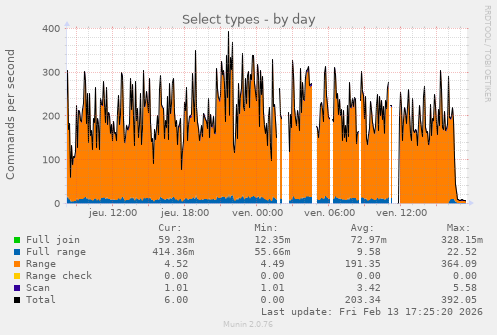
Based on this graph, and this graph alone, guess at what time I completely blocked OpenAI crawlers
from hylobates@jlai.lu to selfhosted@lemmy.world on 13 Feb 2026 08:30
https://jlai.lu/post/33101881
from hylobates@jlai.lu to selfhosted@lemmy.world on 13 Feb 2026 08:30
https://jlai.lu/post/33101881
I really hope they die soon, this is unbearable…
threaded - newest
Acronyms, initialisms, abbreviations, contractions, and other phrases which expand to something larger, that I’ve seen in this thread:
5 acronyms in this thread; the most compressed thread commented on today has 6 acronyms.
[Thread #90 for this comm, first seen 13th Feb 2026, 17:41] [FAQ] [Full list] [Contact] [Source code]
Y’all need to learn to cache things, shiit
This is not how things work on the modern web. Did you just wake up from a 20 year coma?
Whenever you’re browsing even a semi popular website these days there’s probably a 98% chance you’re hitting a cloudflare cached version of it. Have you been asleep the last 10 years?
For static sites, yes. To actually protect dynamic sites against AI crawlers, Cloudflare has to do much more than just caching.
And besides that, Cloudflare is a huge single point of failure and highly privacy invasive.
Dynamic sites still get cached.
Cloudflare definitely is a huge single point of failure, and it is a huge problem imo - but what can we do? Their product is so widely used because of how comprehensive, good, and necessary it is.